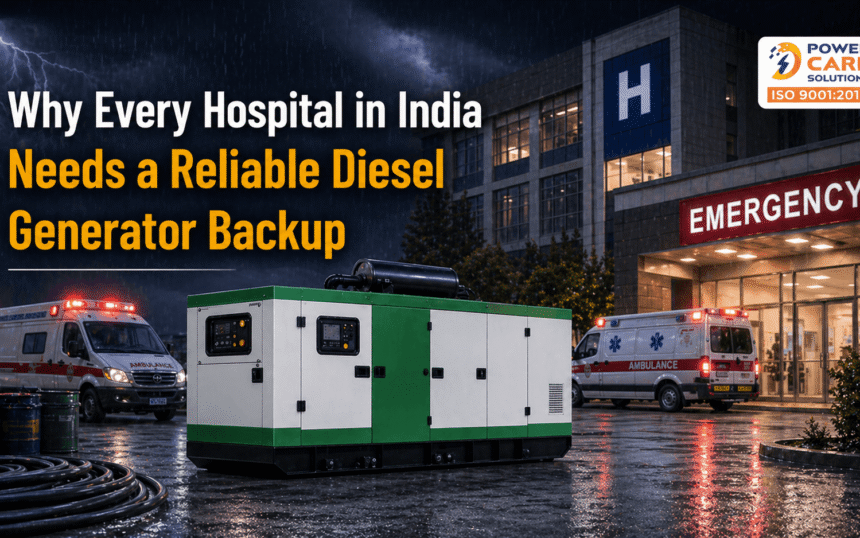
In the fast‑paced world of healthcare, every second matters. Imagine a critical surgery underway. The ventilator hums steadily. The ECG monitors every heartbeat. Suddenly, lights flicker, machines blink, and within moments, total power loss. In an instant, lives hang in the balance.
This is not an imaginary scenario, it is the reality of many hospitals in India without a reliable diesel generator for hospital backup power.
In this comprehensive guide, we will explore why every hospital in India needs a reliable diesel generator backup, how to choose the right system, compliance obligations, and how an expert partner can future‑proof your facility’s power continuity.
Hospital Power Backup System in India: The Critical Risks of Power Outages
Hospitals operate around the clock, every day of the year. Unlike homes or offices, a power cut is not an inconvenience, but it is a critical failure.
Real‑life Risks: ICU and OT Power Failures
Power disruptions in zones like Intensive Care Units (ICU), Operation Theatres (OT), or Neonatal Care can lead to:
- Ventilators shutting down mid‑procedure
- Dialysis pumps losing power during treatment
- Essential lighting failing during surgery
- Life support systems crashing without backup
A hospital without a hospital power backup system in India trusts is not just inefficient, it is unsafe.
Power Outage Statistics in Indian Hospitals
India has made significant improvements to grid stability over the last decade. Yet, power cuts are still common, especially in Tier 2 and Tier 3 cities. In many regions, grid reliability is less than 99%, translating to multiple short interruptions and occasional long outages per month.
Each outage can cost hospitals:
- Loss of revenue
- Delayed procedures
- Emergency evacuations
- Reputation damage among patients and regulators
A reliable diesel generator for hospitals in India is no longer optional, it is essential.
Why Hospitals Cannot Risk Power Cuts
Every modern hospital depends on complex medical equipment that cannot tolerate power interruptions. Even a split‑second lapse can carry grave consequences.
Impact on Critical Medical Equipment
Hospitals rely on life‑critical equipment such as ventilators for respiratory support, dialysis machines for ongoing patient care, operation theatre lights for precise surgeries, and lab analyzers and imaging systems that deliver real‑time diagnostic insights.
Without power backup for medical equipment India relies on, patient care quality plummets instantly.
Threats to Patient Safety and Hospital Operations
An unexpected power outage does more than halt medical equipment; it disrupts hospital operations, compromises patient care, affects communication systems, halts elevators, and creates confusion across critical departments.
- Automatic doors fail
- Elevators halt
- Communication systems break
- EMR (Electronic Medical Records) become inaccessible
For patients, families, and staff alike, this can escalate stress levels and lead to irreversible damage.
Why Silent Generators Are Becoming the Standard in India
With stricter environmental norms and increasing urbanization, silent DG sets are now the preferred choice for most businesses. They ensure compliance, reduce noise pollution, and improve overall operational comfort.
Financial and Reputational Costs of Downtime
Hospitals function as both care centers and businesses. Power outages lead to cancelled surgeries, postponed outpatient treatments, patient transfers, and diminished trust. Investing in a reliable hospital power backup system in India safeguards patient safety and operational continuity.
Diesel Generators – The Life‑Saving Solution
During a grid failure, immediate backup power is essential to maintain hospital operations. Diesel generators equipped with Automatic Mains Failure (AMF) panels automatically start and supply uninterrupted electricity, ensuring critical equipment continues running without any delay.
Instant Backup with Automatic Mains Failure (AMF) Panels
Today’s hospital generators operate automatically, eliminating the need for manual start‑up, ensuring power activates instantly when the grid fails. AMF systems:
- Detect grid failure instantly
- Trigger generator start automatically
- Transfer load seamlessly
- Restore normal power once grid returns
AMF systems remove human delay, providing seamless power continuity, vital for sensitive areas like ICUs and operation theatres.
Ensuring Uninterrupted Power Supply for Medical Equipment
Only a robust diesel generator for hospital backup can handle:
- Inrush current of hospital loads
- Sensitive equipment tolerances
- Long duration runtime without overheating
Compared to UPS systems alone, diesel generators provide sustained runtime and handle higher kVA loads, ensuring all essential systems stay operational until grid power returns.
Large KVA Generators: 50–125 KVA for Hospital Needs
Selecting the appropriate generator size depends on a hospital’s total electrical load and operational needs. For many medium and multi‑specialty hospitals, 50–125 KVA diesel generators provide primary backup for critical departments, act as redundancy for UPS systems, and offer scalable capacity for future expansion. Correct sizing ensures full-load handling with minimal derating, crucial for uninterrupted healthcare operations.
Types of Diesel Generators for Hospitals
Hospitals need power solutions that are not just reliable but also compliant, silent, and efficient.
Silent Diesel Generators – Patient‑friendly and Noise Compliant
Noise control is essential in hospitals, as high sound levels can disturb recovering patients, breach local noise regulations, and disrupt sensitive areas like ICUs and neonatal wards.
Silent diesel generators for hospital use employ acoustic enclosures and vibration‑reducing technology to ensure a quiet, compliant environment that prioritizes patient comfort and safety.
Why are Silent Generators Preferred over Open Frame Generators?
Silent generators are preferred in hospitals over open-frame units because they operate with minimal noise, ensuring patient comfort and compliance with noise regulations. They feature acoustic enclosures and vibration damping, making them ideal for ICUs, wards, and recovery areas.
In contrast, open-frame generators are louder, require separate enclosures, and can disrupt sensitive hospital environments, making silent DG sets the optimal choice for healthcare facilities.
Here is the short summary
| Feature | Silent Generators | Open-Frame Generators |
|---|---|---|
| Noise Level | Minimal, patient-friendly | Loud, can disturb hospital areas |
| Acoustic Design | Equipped with enclosures & vibration damping | No built-in acoustic protection |
| Suitability | Ideal for ICUs, wards, recovery areas | Better for external or isolated locations |
| Regulatory Compliance | Complies with noise regulations | May require additional measures |
| Patient Comfort | Maintains a calm environment | Can cause disturbance to patients |
Choosing the Right Generator Type for Your Facility
Your choice depends on:
- Match generator capacity with hospital load and critical equipment needs.
- Consider noise levels: silent DG sets for patient areas, open-frame for isolated zones.
- Ensure compliance with NABH, CPCB, and fire safety norms.
- Plan for future expansion and scalability of hospital infrastructure.
A trusted diesel generator supplier Chennai hospital administrators prefer will help tailor the ideal solution based on hospital size, load, and clinical priorities.
Compliance and Safety Requirements
Healthcare facilities in India must adhere to multiple standards when selecting backup power.
NABH Accreditation Power Backup Guidelines
The National Accreditation Board for Hospitals & Healthcare Providers (NABH) requires hospitals to have redundant power systems, instant grid-failure transfer, regular maintenance, and sufficient capacity for essential services.
Insufficient backup can lead to accreditation delays, regulatory penalties, and reduced patient confidence in the facility.
CPCB Norms for Diesel Generators in Healthcare
The Central Pollution Control Board (CPCB) sets emissions and environmental standards for diesel generators. Hospitals must ensure:
- DG sets are CPCB‑compliant
- Emissions controls in place
- Regular effluent and exhaust monitoring
Failing CPCB norms can lead to legal action and operational disruptions.
Fire Safety Standards for Hospital Backup Power
Backup generators in hospitals must comply with fire safety regulations by being installed in designated fire-safe areas, equipped with adequate ventilation, fitted with fire suppression systems, and subjected to regular inspections to ensure safe operation, prevent hazards, and maintain uninterrupted hospital power backup.
A power backup for medical equipment India hospitals rely on must meet all safety benchmarks without exception.
How to Size Your Generator: KVA Guide for Hospitals
Determining the right generator size requires precise calculation, considering essential hospital loads, potential future expansion, and redundancy needs to ensure reliable, uninterrupted power for all critical equipment and operations.
Calculating Load Based on Beds × Equipment
A basic hospital load estimation may consider:
- 1.5–2 kVA per hospital bed
- Additional load for OT, ICU, radiology, labs
- HVAC (Heating, Ventilation & Air Conditioning)
- Communication & IT infrastructure
For example, a 100‑bed hospital with critical departments typically requires 75–125 kVA of standby power.
Example: 100‑bed Hospital KVA Requirements
| Department | Estimated Load |
|---|---|
| ICU & Ventilation | 20–30 kVA |
| Operation Theatre | 15–25 kVA |
| Labs & Imaging | 20–35 kVA |
| HVAC & Lights | 30–40 kVA |
| Total | 85–130+ kVA |
This illustrates why 50–125 kVA generators are best suited for most Indian hospitals.
Planning for Future Expansion
Hospitals expand over time, so planning hospital power backup systems India with load margins and redundancy ensures higher uptime, supports additional wards, allows parallel DG configurations, and avoids costly generator replacements later.
AMC and Maintenance: Keeping Generators Reliable
Even the best diesel generator for hospitals in India cannot guarantee reliability without proper maintenance. Regular servicing, timely repairs, and professional AMC support are essential to ensure uninterrupted power supply and optimal performance.
Importance of Annual Maintenance Contracts for Hospitals
AMCs ensure:
- Quarterly servicing
- Fuel system checks
- Exhaust and emissions testing
- AMF panel calibration
- Emergency breakdown support
Without AMC, even the best generators can fail, often at the worst possible moment.
Choosing a Trusted Diesel Generator Supplier in Chennai
PowerCare Solutions, a trusted diesel generator supplier for hospitals in Chennai, is renowned for delivering customized, reliable, and compliant backup power solutions tailored to meet the critical needs of healthcare facilities.
- Tailored hospital power solutions
- CPCB‑compliant and silent DG systems
- Certified installation and commissioning
- Comprehensive AMC and rapid response teams
A trusted supplier becomes a partner, not just a vendor.
24/7 Support to Avoid Critical Failures
Hospitals run round the clock, and your diesel generator supplier must provide continuous support. Fast response to breakdowns, along with remote monitoring and diagnostics, ensures uninterrupted power, safeguarding patient care and critical hospital operations.
Conclusion – Secure Your Hospital’s Power Today
Power outages are unpredictable, but your hospital’s preparedness does not have to be. PowerCare Solutions provide reliable diesel generators for hospitals in India, designed for compliance, AMC support, and uninterrupted performance.
Safeguard patient lives, hospital reputation, and operational continuity with NABH‑compliant, CPCB‑ready, and silent solutions, plus 24/7 technical support. Get a free hospital power assessment today.
Contact us today for a free hospital power backup assessment and quote!
FAQs
What is the ideal diesel generator size for a hospital in India?
A medium hospital typically requires 50–125 KVA generators, depending on beds, OT, ICU, and equipment load for reliable hospital power backup systems India.
Why are silent diesel generators preferred for hospitals?
Silent generators for hospitals reduce noise, ensure patient comfort, and comply with NABH and local CPCB norms, unlike open-frame units.
How does an AMF panel work in hospital generators?
An Automatic Mains Failure (AMF) panel detects grid failure and starts the generator instantly, providing uninterrupted power for ICU, OT, and essential equipment.
How can PowerCare Solutions support hospital power backup needs?
PowerCare Generators offer customized sizing, NABH-compliant systems, silent DG sets, and 24/7 AMC support for uninterrupted hospital operations.
Why choose PowerCare Generators for healthcare facilities in Chennai?
With expertise in diesel generators for hospitals in India, PowerCare provides reliable backup, compliance guidance, scalable solutions, and rapid maintenance support.